CSCA MATHEMATICS · MODULE 02 · FUNCTIONS
Monotonicity of Functions
Increasing and decreasing functions, slope, quadratic turning points, monotonic intervals, and CSCA-style practice.
1. Understanding Monotonicity
Monotonicity describes how the output changes as the input increases. Read graphs from left to right.
| Behavior | Output change | Appearance |
|---|---|---|
| Increasing | Becomes larger | Graph rises ↗ |
| Decreasing | Becomes smaller | Graph falls ↘ |
| Constant | Remains the same | Graph stays horizontal → |
Example 1 · Increasing Function
As the input increases, the output increases.
Example 2 · Decreasing Function
As the input increases, the output decreases.
Increasing and Decreasing Lines
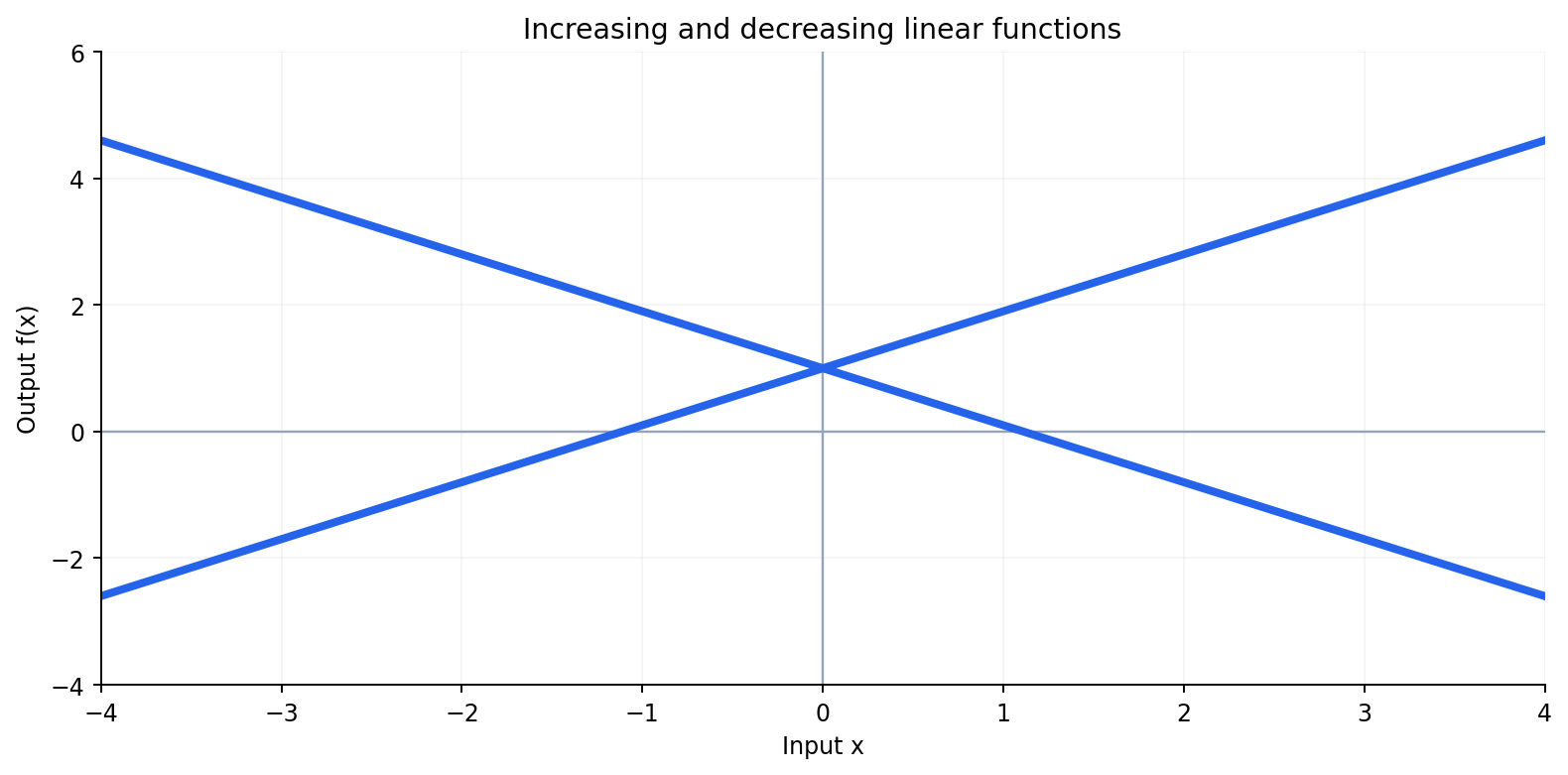
Important distinction
A few calculated values illustrate a pattern. To prove monotonicity over an entire interval, use the complete graph, the function rule, or the mathematical definition.
2. Definitions of Increasing and Decreasing
Always state the interval on which monotonicity holds. Choose any two inputs in that interval:
2.1 Strictly Increasing
Every larger input produces a strictly larger output.
For instance, if f is strictly increasing on [0,10], then 2 < 7 implies f(2) < f(7).
2.2 Strictly Decreasing
Every larger input produces a strictly smaller output.
For instance, if f is strictly decreasing on [−5,5], then −3 < 4 implies f(−3) > f(4).
Terminology
In this lesson, “increasing” and “decreasing” mean strictly increasing and strictly decreasing unless otherwise specified. Some textbooks use different conventions.
3. Strict versus Non-Strict Monotonicity
3.1 Non-Decreasing
A non-decreasing function may rise or remain flat, but cannot fall.
Example 3 · A Flat Section
Let h(x) = 0 when x ≤ 0, and h(x) = x when x > 0.
It never decreases, but it is not strictly increasing on its full real domain, because distinct negative inputs have the same output.
3.2 Non-Increasing
A non-increasing function may fall or remain flat, but cannot rise.
A constant function such as f(x) = 5 is both non-decreasing and non-increasing; it is not strictly monotonic on any interval containing more than one point.
| Type | For x₁ < x₂ | Equal outputs allowed? |
|---|---|---|
| Strictly increasing | f(x₁) < f(x₂) | No |
| Non-decreasing | f(x₁) ≤ f(x₂) | Yes |
| Strictly decreasing | f(x₁) > f(x₂) | No |
| Non-increasing | f(x₁) ≥ f(x₂) | Yes |
4. Identifying Monotonic Intervals from Graphs
- Check the domain.
- Read the graph from left to right.
- Identify rising, falling and horizontal sections.
- Locate changes of direction.
- Report the corresponding input intervals.
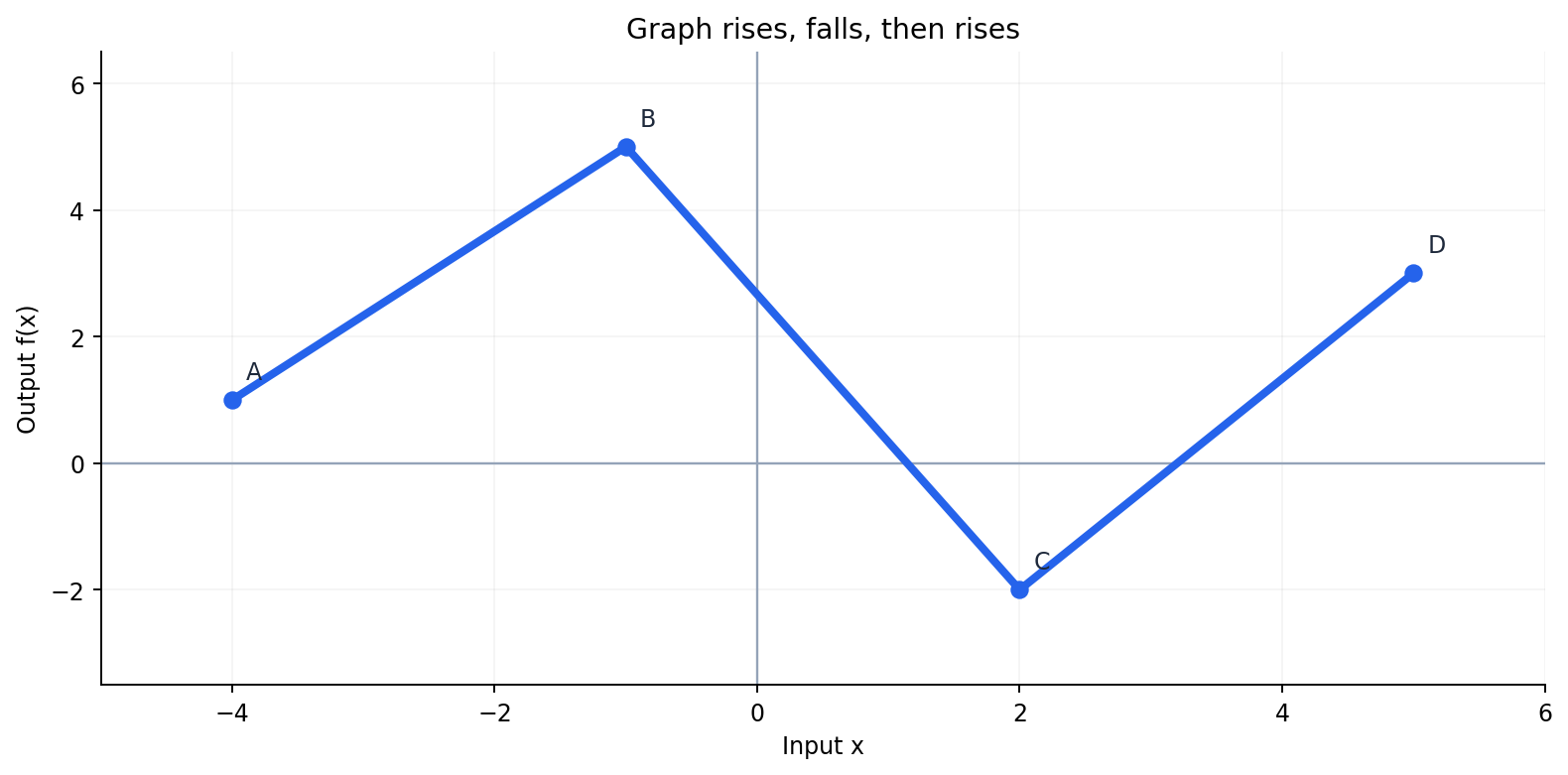
Example 4 · A Graph with Three Sections
Join the points (−4,1), (−1,5), (2,−2), (5,3) in order by straight segments.
Increasing: [−4,−1] and [2,5].
Decreasing: [−1,2].
Direction changes at x = −1 and x = 2.
Piecewise Graph · Increasing, Decreasing, Increasing
Endpoints
The full closed monotonic sections above include their turning points. Open intervals are also commonly reported in textbooks. Follow the question’s requested endpoint convention.
Important · Increasing Does Not Mean Positive
−9 < −7, so the function increases even though both outputs are negative.
5. Monotonicity of Linear Functions
The slope m determines the behavior.
| Slope | Behavior | Example |
|---|---|---|
| m > 0 | Strictly increasing | f(x) = 4x − 7 |
| m < 0 | Strictly decreasing | g(x) = 9 − x/2 |
| m = 0 | Constant | h(x) = 6 |
Why Slope Determines Monotonicity
Because x₂ − x₁ is positive when x₁ < x₂, the sign of the output difference is the sign of m. The constant b cancels.
Quick Check
The slope is −3, so p is strictly decreasing over all real numbers.
6. Monotonicity of Quadratic Functions
eq0\]
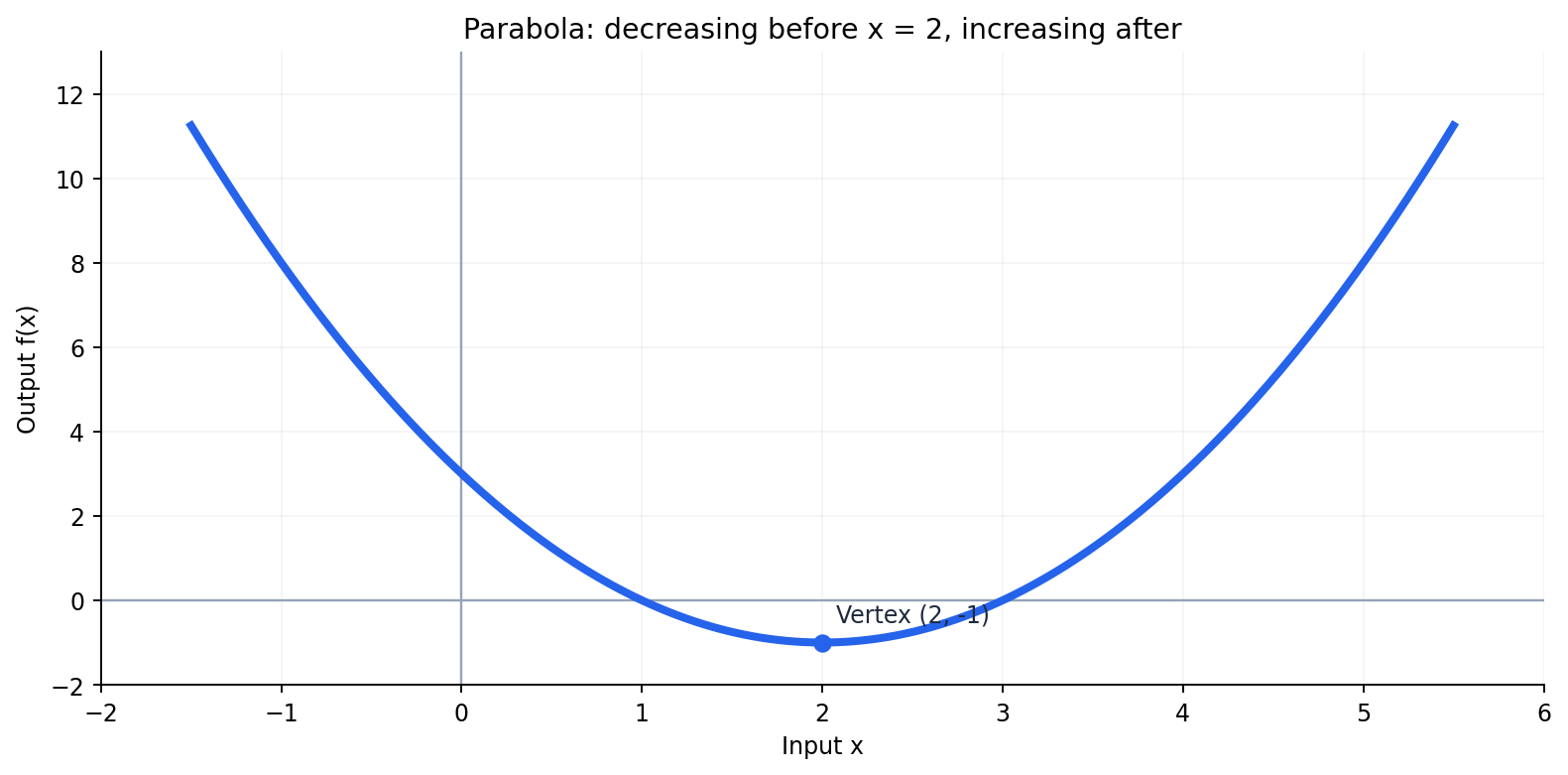
The graph is a parabola. Its vertex is the turning point.
6.1 Upward-Opening Quadratic
If a > 0, the function decreases toward the vertex (minimum) and increases afterward.
Example 5 · Minimum at the Vertex
Decreasing: (−∞,2]. Increasing: [2,∞). Minimum value: −1 at x = 2.
Upward Quadratic · Vertex and Monotonicity
6.2 Downward-Opening Quadratic
If a < 0, the function increases toward the vertex (maximum) and decreases afterward.
Example 6 · Maximum at the Vertex
Increasing: (−∞,−1]. Decreasing: [−1,∞). Maximum value: 5 at x = −1.
| Opening | Increasing on | Decreasing on | Vertex |
|---|---|---|---|
| Upward (a > 0) | [h, ∞) | (−∞, h] | Minimum |
| Downward (a < 0) | (−∞, h] | [h, ∞) | Maximum |
7. Comparing Function Values Using Monotonicity
Example 7 · Increasing
If f is strictly increasing on [0,10], then:
Example 8 · Decreasing
If g is strictly decreasing on [−5,5], then:
Example 9 · Negative Inputs
f(x) = x² decreases on (−∞,0]. Since −5 < −2:
Check the Interval
If inputs lie on opposite sides of a turning point, a single monotonicity rule may not apply across both. For example, f(−3) = 9 and f(2) = 4 for f(x) = x²; compare directly.
8. Understanding Turning Points
A turning point is where a graph changes from increasing to decreasing (local maximum) or decreasing to increasing (local minimum).
Local Maximum
Turning point (2,7); input where the maximum occurs: x = 2; maximum value: 7.
Local Minimum
Turning point (−3,−4); input where minimum occurs: x = −3; minimum value: −4.
Local extrema compare nearby outputs; absolute extrema compare all outputs in the domain. The vertex of a quadratic on all real numbers is an absolute extremum.
Do not confuse
A zero or x-intercept is not automatically a turning point. Zeros describe where f(x) = 0; turning points describe a change in direction.
9. Restricted Domains
Example 10 · Vertex Inside the Domain
Vertex (3,2). Decreasing on [0,3]; increasing on [3,5]. Do not extend beyond the allowed domain.
Example 11 · Domain Right of the Vertex
The whole domain lies to the right of x = 3. Strictly increasing throughout [4,8].
10. Common Mistakes and How to Avoid Them
| Mistake | Better approach |
|---|---|
| Reading the graph right to left | Always follow increasing x. |
| Assuming negative outputs mean decreasing | Look at output changes, not whether outputs are below zero. |
| Claiming x² increases everywhere | Locate the vertex: decreases before 0, increases after 0. |
| Using quadratic roots as monotonic boundaries | Use the vertex rather than x-intercepts. |
| Comparing inputs from different monotonic sections | Confirm both inputs lie in the same interval of the stated behavior. |
| Joining separate increasing sections | Report the increasing intervals separately. |
11. Practice Quiz
Attempt these ten questions before reading the solutions. These are formative lesson questions, not an official CSCA sample exam.
Question 1 · Definition
For x₁ < x₂, which relationship defines a strictly decreasing function?
Question 2 · Linear function
Classify f(x) = 12 − 5x as increasing, decreasing, or constant, and explain why.
Question 3 · Strict vs. non-strict
A function rises, remains horizontal over a nonzero interval, then rises again. It never falls. Choose: A strictly increasing; B non-decreasing but not strictly increasing; C strictly decreasing; D constant.
Question 4 · Quadratic
Find intervals of increase and decrease for f(x) = x² + 6x + 5.
Question 5 · Downward quadratic
Find vertex and monotonic intervals for g(x) = −(x − 4)² + 9.
Question 6 · Compare outputs
h is strictly decreasing on [−3,8]. Compare h(−1) and h(6).
Question 7 · Negative inputs
For f(x) = x², compare f(−7) and f(−3) using monotonicity.
Question 8 · Turning point
A continuous graph decreases from x = −5 to 1 then increases from 1 to 6; sections meet at (1, −4). Identify the turning point type.
Question 9 · Restricted domain
Find increasing and decreasing intervals of f(x) = (x − 2)² on −1 ≤ x ≤ 4.
Question 10 · Explain the error
A student says: “The graph is below the x-axis, so the function must be decreasing.” Explain with a counterexample.
12. Answers and Explanations
Answer 1
For x₁ < x₂, strictly decreasing means f(x₁) > f(x₂).
Answer 2
Strictly decreasing on all real numbers: slope m = −5 < 0.
Answer 3
B. The function is non-decreasing, but not strictly increasing because the flat portion produces equal outputs.
Answer 4
Vertex x = −3. Decreasing on (−∞,−3] and increasing on [−3,∞).
Answer 5
Vertex (4,9). Increasing on (−∞,4], decreasing on [4,∞).
Answer 6
h(−1) > h(6), because −1 < 6 and h is decreasing throughout the relevant interval.
Answer 7
f(−7) > f(−3); indeed 49 > 9. Both inputs lie left of 0, where x² decreases.
Answer 8
(1,−4) is a local minimum: the graph changes from decreasing to increasing.
Answer 9
Decreasing on [−1,2], increasing on [2,4].
Answer 10
Negative outputs do not determine monotonicity. f(x) = x − 10 on [0,5] has negative outputs but increases because its slope is +1.
13. Lesson Review
- Read graphs left to right.
- Use the definition to distinguish strictly and non-strictly monotonic functions.
- Classify linear functions by slope.
- Find the vertex to divide quadratic monotonic intervals.
- Compare function values only on a valid monotonic interval.
- Distinguish local minima/maxima from roots.
- Restrict every answer to the stated domain.
Two Central Comparison Rules
Strictly increasing
Strictly decreasing