03.7.1 Introduction to Vectors
A vector is a mathematical quantity that has both magnitude and direction.
Magnitude describes the size or length of the vector. Direction describes where the vector points.
For example, a displacement of 5 meters east is a vector because it specifies both a distance and a direction.
A temperature of 25°C is a scalar because it has a numerical value but no direction.
Scalars and vectors
A scalar has magnitude only. A vector has magnitude and direction.
Common scalar quantities include mass, time, temperature, and distance.
Common vector quantities include displacement, velocity, acceleration, and force.
In mathematics, vectors are usually written with an arrow above a letter or in bold:
A vector from point \(A\) to point \(B\) is written:
Point \(A\) is the initial point, while point \(B\) is the terminal point.
Basic vector terminology
Magnitude: The length of a vector, written \(|\vec a|\) or \(\|\vec a\|\).
Direction: The orientation in which the vector points.
Equal vectors: Vectors with the same components, and hence the same magnitude and direction, regardless of where they are drawn.
Opposite vectors: Vectors with equal magnitudes but opposite directions.
Zero vector: A vector whose components are all zero:
Its magnitude is zero, and its direction is undefined.
Unit vector: A vector with magnitude exactly 1.
Example 1 — Equal and opposite vectors
Suppose:
Both vectors have identical horizontal and vertical components.
Therefore:
Now let:
Then:
The vectors \(\vec a\) and \(\vec c\) have equal lengths but point in opposite directions.
Key concept: A vector’s position on a diagram does not determine its value. For free vectors, magnitude and direction do.
03.7.2 Coordinate Representation of Vectors
Vectors in a two-dimensional Cartesian coordinate system can be described using ordered pairs.
A vector:
has two components:
-
\(a_x\): horizontal component.
-
\(a_y\): vertical component.
A positive horizontal component points to the right, while a negative one points to the left.
A positive vertical component points upward, while a negative one points downward.
For example:
represents a displacement of 4 units to the right and 3 units upward.
Position vectors
A position vector starts at the origin \(O=(0,0)\) and ends at a particular point.
For a point:
its position vector is:
Vectors between two points
Suppose:
The vector from \(A\) to \(B\) is:
Remember: End point minus start point.
Example 2 — Finding a vector between two points
Given:
Find \(\overrightarrow{AB}\).
Step 1. Apply the coordinate formula.
Step 2. Simplify.
Final answer:
This means moving 6 units right and 4 units downward from point \(A\).
The reverse vector is:
Therefore:
Standard unit vectors
Two important coordinate unit vectors are:
Here, \(\vec i\) points along the positive x-axis and \(\vec j\) along the positive y-axis.
Any plane vector can be expressed as:
For example:
This notation is useful when working with coordinate components.
03.7.3 Vector Magnitude and Unit Vectors
The magnitude of a vector measures its length.
For:
the Pythagorean theorem gives:
The magnitude is always nonnegative.
The magnitude is zero only when both components equal zero.
Example 3 — Calculate vector magnitude
Given:
Find \(|\vec a|\).
Step 1. Substitute the components.
Step 2. Simplify.
Final answer:
Example 4 — Magnitude of a vector with negative components
Given:
Calculate the magnitude.
A negative component does not produce a negative magnitude.
Unit vectors
A unit vector has a magnitude of 1.
For any nonzero vector \(\vec a\), the unit vector in the same direction is:
We divide each component by the vector’s magnitude.
Example 5 — Find a unit vector
Given:
Find the unit vector in its direction.
We already know:
Therefore:
Verification
Thus, the result is a unit vector.
Important: The zero vector has no associated unit vector in its direction, because division by its magnitude would require division by zero.
03.7.4 Vector Addition and Subtraction
Vectors can be added and subtracted using their coordinate components.
Vector addition
For:
their sum is:
Add horizontal components together and vertical components together.
Example 6 — Adding two vectors
Given:
Find \(\vec a+\vec b\).
Final answer:
Geometric meaning of addition
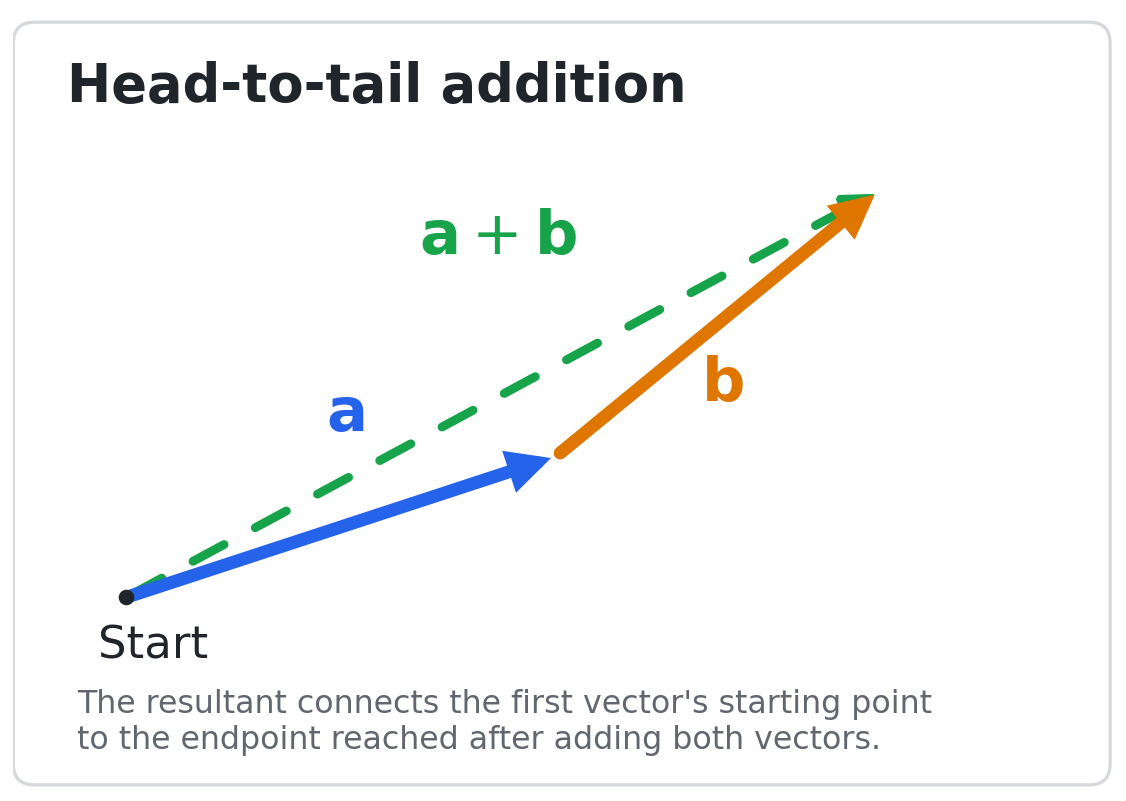
There are two useful geometric constructions.
Head-to-tail rule: Move the second vector so that its tail starts at the head of the first. The resultant vector goes from the first vector’s tail to the second vector’s head.
Parallelogram rule: Draw both vectors from a common starting point. The diagonal of the parallelogram formed by the two vectors represents their sum.
Vector subtraction
Subtracting a vector is equivalent to adding its opposite.
In coordinates:
Example 7 — Subtracting vectors
Given:
Calculate:
Final answer:
Essential properties of vector addition
For any plane vectors \(\vec a,\vec b,\vec c\):
Commutative property
Associative property
Additive identity
Additive inverse
Vector subtraction is not generally commutative:
unless \(\vec a=\vec b\).
03.7.5 Scalar Multiplication and Vector Equations
Multiplying a vector by a scalar changes its length and may reverse its direction.
For a scalar \(k\):
Effect of scalar multiplication
When \(k>0\), the vector keeps its direction.
When \(k<0\), the vector reverses direction.
When \(k=0\), the result is the zero vector.
The magnitude satisfies:
Example 8 — Scalar multiplication
Given:
Calculate:
Multiply each component by −3:
Final answer:
The resulting vector is three times as long as \(\vec a\) and points in the opposite direction.
Example 9 — Combining vector operations
Given:
Calculate:
First:
Then:
Subtract:
Final answer:
Example 10 — Solve a vector equation
Given:
Find \(\vec b\) if:
Rearrange:
Calculate:
Therefore:
Final answer:
Verification
The vector equation is satisfied.
03.7.6 Dot Product of Two Vectors
The dot product, also called the scalar product, is an operation that combines two vectors and produces a scalar.
For plane vectors:
the dot product is:
Unlike vector addition, the result is a number, not a vector.
Example 11 — Calculate a dot product
Given:
Calculate \(\vec a\cdot\vec b\).
Step 1. Multiply corresponding components.
Step 2. Add the products.
Final answer:
Geometric interpretation of the dot product
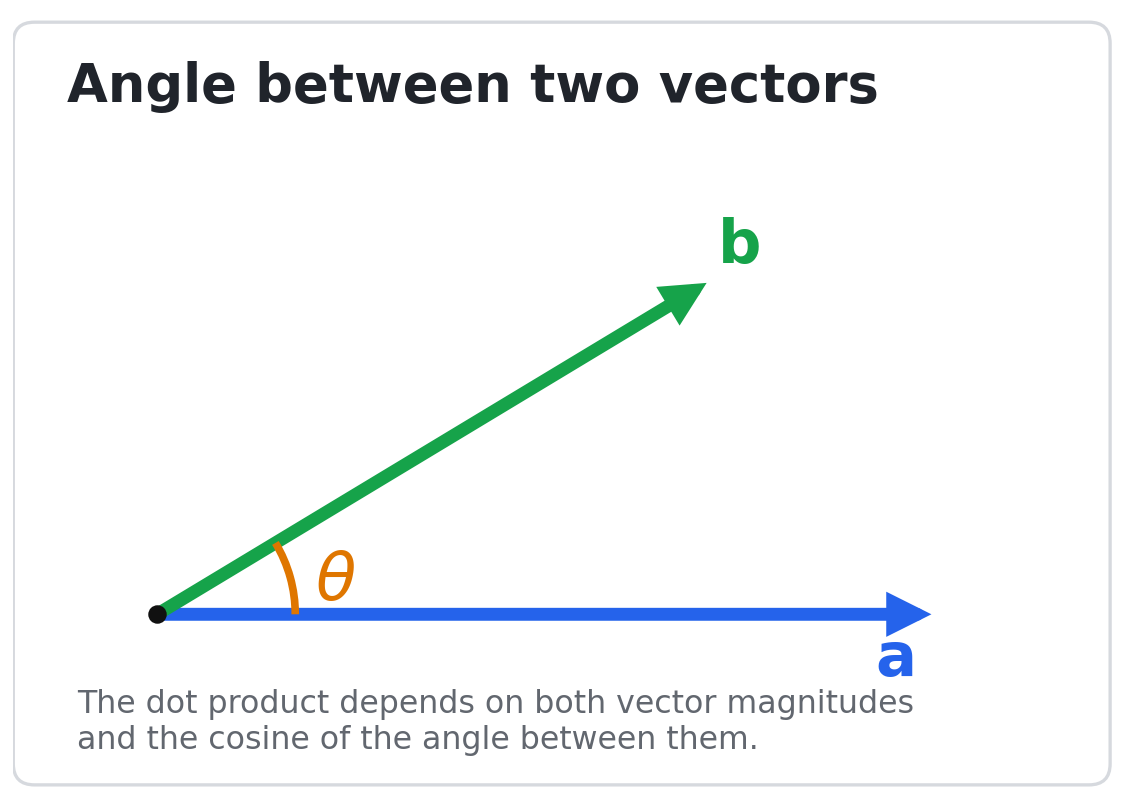
For two nonzero vectors, the dot product can also be calculated using the angle \(\theta\) between them.
where the angle is taken between 0° and 180°.
This connects vector algebra with trigonometry.
Example 12 — Finding the angle between vectors
Given:
Find the smaller angle between them.
Step 1. Calculate the dot product.
Step 2. Calculate the magnitudes.
Step 3. Apply the geometric formula.
Therefore:
Since the angle between vectors lies between 0° and 180°:
Final answer: 45°.
Important dot-product properties
Commutativity
Distributivity
Scalar multiplication
Dot product with itself
Sign interpretation for nonzero vectors
| Dot product | Angle between vectors |
|---|---|
| Positive | Acute, between 0° and 90° |
| Zero | Exactly 90° |
| Negative | Obtuse, between 90° and 180° |
For nonzero vectors, a positive dot product means the angle is acute, while a negative dot product means the angle is obtuse.
A zero dot product means the vectors are perpendicular.
The zero-vector case requires separate treatment because the zero vector has no defined direction or angle.
03.7.7 Parallel and Perpendicular Vectors
Two important geometric relationships between vectors are parallelism and perpendicularity.
Parallel vectors
Two nonzero vectors are parallel if one is a nonzero scalar multiple of the other.
for some nonzero scalar \(k\).
If \(k>0\), they point in the same direction.
If \(k<0\), they point in opposite directions.
Both cases are parallel.
For two plane vectors:
a useful test is:
For nonzero vectors, this condition is equivalent to parallelism.
Example 13 — Determine whether vectors are parallel
Given:
We observe:
because:
Therefore, the vectors are parallel and point in the same direction.
Final answer: Parallel.
Example 14 — Find an unknown component using parallelism
Given:
Find \(k\) if the vectors are parallel.
Apply the component test:
Therefore:
When \(k=4\):
This confirms parallelism.
Perpendicular vectors
Two vectors are perpendicular when the angle between them is 90°.
For two nonzero vectors:
if and only if:
In coordinates:
Example 15 — Checking perpendicularity
Given:
Calculate their dot product.
Both vectors are nonzero.
Therefore, they are perpendicular.
Final answer:
Example 16 — Find an unknown component
Given:
Find \(k\) if the vectors are perpendicular.
Step 1. Set their dot product equal to zero.
Step 2. Simplify.
Final answer:
Verification:
The vectors are perpendicular.
03.7.8 Vector Applications in Plane Geometry
Vectors can simplify geometric calculations involving displacement, distance, direction, and special points.
Example 17 — Resultant displacement
A student walks 5 meters east, then 12 meters north.
Represent the two displacements as:
The resultant displacement is:
Its magnitude is:
Final answer: The displacement is 13 meters in the northeast direction, with components 5 meters east and 12 meters north.
If \(\theta\) is measured north of east:
Thus:
Example 18 — Direction components
A vector has magnitude 10 and points at an angle of 30° counterclockwise from the positive x-axis.
Its components are:
Since:
we obtain:
Final answer:
Example 19 — Midpoint using position vectors
Suppose:
The midpoint \(M\) of segment \(AB\) has coordinates:
Substitute:
In position-vector form:
This connects coordinate geometry with vector addition and scalar multiplication.
Example 20 — Recognizing a right angle in a triangle
Given:
Determine whether angle \(BAC\) is a right angle.
First, calculate the two vectors originating at \(A\):
Calculate the dot product:
Both vectors are nonzero, so they are perpendicular.
Final answer: Angle \(BAC=90^\circ\). The triangle is right-angled at \(A\).
| Operation | Formula |
|---|---|
| Vector between points | \(\overrightarrow{AB}=(x_B-x_A,\ y_B-y_A)\) |
| Magnitude | \(|\vec a|=\sqrt{a_x^2+a_y^2}\) |
| Unit vector | \(\hat a=\frac{\vec a}{|\vec a|},\quad\vec a\ne\vec0\) |
| Addition | \(\vec a+\vec b=(a_x+b_x,\ a_y+b_y)\) |
| Subtraction | \(\vec a-\vec b=(a_x-b_x,\ a_y-b_y)\) |
| Scalar multiplication | \(k\vec a=(ka_x,\ ka_y)\) |
| Dot product | \(\vec a\cdot\vec b=a_xb_x+a_yb_y\) |
| Angle between vectors | \(\cos\theta=\frac{\vec a\cdot\vec b}{|\vec a||\vec b|}\) |
| Perpendicularity | \(\vec a\cdot\vec b=0\) |
| Parallelism | \(a_xb_y-a_yb_x=0\) |
| Direction components | \((r\cos\theta,\ r\sin\theta)\) |
Note: Angle, unit-vector, and parallel/perpendicular interpretations require nonzero vectors where applicable.
Common mistakes
Mistake 1: Reversing endpoint subtraction.
For \(\overrightarrow{AB}\), calculate \(B-A\), not \(A-B\).
Mistake 2: Adding magnitudes instead of components.
In general:
The equality holds for vectors pointing in the same direction, including the appropriate zero-vector cases.
Mistake 3: Forgetting negative components.
For example:
not \((2,2)\).
Mistake 4: Confusing a dot product with a vector.
The result is the scalar 23, not the vector \((8,15)\).
Mistake 5: Ignoring vector magnitudes when finding angles.
The dot product alone is not the cosine of the angle. Divide by the product of the magnitudes.
Mistake 6: Assuming a zero dot product always defines a 90° angle.
The zero vector has a zero dot product with every vector, but it has no defined direction. The usual angle interpretation requires both vectors to be nonzero.
Mistake 7: Treating parallel vectors as necessarily equal.
For example:
are parallel but not equal.
Mistake 8: Dividing by the magnitude of the zero vector.
A unit vector cannot be formed from the zero vector.
Final theory summary
To solve elementary vector problems accurately, students should first identify whether the task involves a vector or a scalar, express the vectors in coordinates, apply the relevant operation component by component, and interpret the result geometrically.
The most important calculation skills are vector addition and subtraction, scalar multiplication, magnitude, dot product, parallelism, and perpendicularity.
Guided Practice — 03.7 Vectors
Students should attempt all 10 problems before consulting the worked solutions.
Practice Questions
Practice 1 — Vector between points
Given \(A=(-3,2)\) and \(B=(4,6)\), find \(\overrightarrow{AB}\) and its magnitude.
Practice 2 — Addition and subtraction
Given:
Calculate \(\vec a+\vec b\) and \(\vec a-\vec b\).
Practice 3 — Combined scalar operations
Given:
Calculate \(2\vec a-3\vec b\).
Practice 4 — Unit vector
Find the unit vector in the direction of \(\vec a=(-5,12)\).
Practice 5 — Distance and midpoint
Given:
Find \(\overrightarrow{PQ}\), the distance \(PQ\), and the midpoint of \(PQ\).
Practice 6 — Dot product
Given:
Calculate \(\vec a\cdot\vec b\).
Practice 7 — Perpendicular vectors
Find \(k\) if the vectors \((k,3)\) and \((6,-2)\) are perpendicular.
Practice 8 — Parallel vectors
Find \(k\) if the nonzero vectors \((k,4)\) and \((3,2)\) are parallel.
Practice 9 — Angle between vectors
Find the smaller angle between:
Practice 10 — Resultant displacement
A student moves 5 meters east, then 12 meters north. Find the resultant displacement vector, magnitude, and direction measured counterclockwise from east.
Complete Guided Practice Solutions
Solution 1
Use endpoint minus starting point.
Magnitude:
Answer: \((7,4)\), magnitude \(\sqrt{65}\).
Solution 2
Addition:
Subtraction:
Answer: Sum \((2,2)\); difference \((6,-8)\).
Solution 3
Therefore:
Answer: \((8,1)\).
Solution 4
Magnitude:
Divide each component by 13:
Answer: \(\left(-\frac5{13},\frac{12}{13}\right)\).
Solution 5
Vector:
Distance:
Midpoint:
Answer: \(\overrightarrow{PQ}=(-6,8)\), distance 10, midpoint \((-1,3)\).
Solution 6
Answer: 5.
Solution 7
For perpendicular nonzero vectors:
Therefore:
Answer: 1.
Solution 8
For parallel vectors, apply:
Verification: \((6,4)=2(3,2)\).
Answer: 6.
Solution 9
Dot product:
Magnitudes:
Thus:
Therefore:
Answer: 60°.
Solution 10
Represent east as the positive x-direction and north as the positive y-direction.
Resultant:
Magnitude:
Direction:
Answer: \((5,12)\), magnitude 13 meters, approximately 67.4° north of east.
03.7 Follow-Up Quiz — Vectors: Concepts, Operations & Properties
This is an original CSCA-style practice assessment, not a reproduction of official examination questions.
Recommended Tutor LMS Settings
Quiz title:
03.7 Quiz – Vectors: Concepts, Operations & Properties
Question type:
Single Choice (one correct answer per question)
Scoring:
1 mark per question; at least 8 correct to pass.
Feedback:
Display answers and explanations after submission.
Student-Facing Assessment
Question 1 — Vector and scalar quantities
Which of the following is a vector quantity?
A. Mass
B. Temperature
C. Speed
D. Displacement
Question 2 — Vector between two points
Given:
Find \(\overrightarrow{AB}\).
A. \((-4,-3)\)
B. \((4,3)\)
C. \((6,-1)\)
D. \((4,-3)\)
Question 3 — Vector magnitude
Find the magnitude of:
A. \(10\)
B. \(14\)
C. \(\sqrt{28}\)
D. \(100\)
Question 4 — Vector addition
Given:
Find \(\vec a+\vec b\).
A. \((8,-6)\)
B. \((-2,-6)\)
C. \((-2,2)\)
D. \((2,-2)\)
Question 5 — Vector subtraction
Given:
Find \(\vec a-\vec b\).
A. \((1,6)\)
B. \((5,4)\)
C. \((-5,4)\)
D. \((5,-4)\)
Question 6 — Scalar multiplication
Given:
Calculate \(3\vec a\).
A. \((6,-3)\)
B. \((5,2)\)
C. \((6,3)\)
D. \((2,-3)\)
Question 7 — Dot product
Given:
Calculate \(\vec a\cdot\vec b\).
A. \(14\)
B. \(10\)
C. \(-10\)
D. \(6\)
Question 8 — Perpendicular vectors
The nonzero vectors:
are perpendicular.
Find \(k\).
A. \(-3\)
B. \(2\)
C. \(3\)
D. \(-2\)
Question 9 — Angle between vectors
Find the smaller angle between:
A. \(0^\circ\)
B. \(45^\circ\)
C. \(180^\circ\)
D. \(90^\circ\)
Question 10 — Vector equation
Given:
and:
find \(\vec b\).
A. \((4,-6)\)
B. \((2,2)\)
C. \((-4,6)\)
D. \((4,6)\)
Instructor Answer Key and Complete Explanations
Keep this section separate from the student-facing reading lesson and quiz questions.
Question 1 — D. Displacement
Displacement has magnitude and direction. Mass, temperature, and speed are scalars.
Question 2 — B. \((4,3)\)
Question 3 — A. \(10\)
Question 4 — C. \((-2,2)\)
Question 5 — D. \((5,-4)\)
Question 6 — A. \((6,-3)\)
Question 7 — B. \(10\)
Question 8 — C. \(3\)
Because the vectors are perpendicular:
Question 9 — D. \(90^\circ\)
The dot product is:
Both vectors are nonzero, so they are perpendicular.
Therefore, the smaller angle is 90°.
Question 10 — A. \((4,-6)\)
Rearrange:
| Question | Correct option | Correct answer |
|---|---|---|
| 1 | D | Displacement |
| 2 | B | (4, 3) |
| 3 | A | 10 |
| 4 | C | (-2, 2) |
| 5 | D | (5, -4) |
| 6 | A | (6, -3) |
| 7 | B | 10 |
| 8 | C | 3 |
| 9 | D | 90 degrees |
| 10 | A | (4, -6) |
Vector Operations: Coordinate Method
Given \(\vec a=(2,3)\) and \(\vec b=(4,-1)\)
Addition, subtraction, and scalar multiplication produce vectors.
The dot product produces a scalar.