CSCA MATHEMATICS · MODULE 02 · LESSON 02.3
Even & Odd Functions — Function Parity
Understand the algebraic tests, graphical symmetry, domain requirements, common function types and exam-style applications.
02.3.1 Understanding Function Parity
Parity describes the relationship between a function’s outputs at opposite inputs. Compare a positive input and its negative.
Introduction · Even behavior
\[f(x)=x^2\]
\[f(3)=9,\qquad f(-3)=9\]
\[f(-x)=f(x)\]
Squaring opposite inputs produces the same output.
Introduction · Odd behavior
\[g(x)=x^3\]
\[g(2)=8,\qquad g(-2)=-8\]
\[g(-x)=-g(x)\]
Cubing opposite inputs produces opposite outputs.
Domain first
The function must be defined at both x and −x for the parity relationship to apply throughout its domain.
02.3.2 Even Functions
An even function has a domain symmetric about zero and satisfies the following identity for every input in its domain:
Example 1 · Squaring
\[f(x)=x^2\]
\[f(-x)=(-x)^2=x^2\]
\[f(-x)=f(x)\]
Therefore, f is even.
Example 2 · Even Polynomial
\[f(x)=3x^4-2x^2+7\]
\[f(-x)=3(-x)^4-2(-x)^2+7\]
\[=3x^4-2x^2+7=f(x)\]
All powers are even and the constant term is unchanged, so the function is even.
Common even functions on their natural domains:
Their graphs are symmetric about the y-axis. An even constant function need not be zero.
02.3.3 Odd Functions
An odd function has a domain symmetric about zero and satisfies the following identity for every input in its domain:
Example 3 · Cubing
\[f(x)=x^3\]
\[f(-x)=(-x)^3=-x^3\]
\[f(-x)=-f(x)\]
Therefore, f is odd.
Example 4 · Odd Polynomial
\[f(x)=2x^5-3x^3+x\]
\[f(-x)=-2x^5+3x^3-x\]
\[-f(x)=-2x^5+3x^3-x\]
The two expressions are identical, so f is odd.
If an odd function is defined at zero, then:
However, the odd function below is undefined at zero and is still odd on its natural domain:
Common odd functions include:
02.3.4 Graphical Symmetry of Even and Odd Functions
| Classification | Symmetry | Related points |
|---|---|---|
| Even | Reflection across the y-axis | (a,b) and (−a,b) |
| Odd | 180° rotation around the origin | (a,b) and (−a,−b) |
| Neither | No parity symmetry required | No universal pairing rule |
The following comparison uses \(y=x^2\) as an even example and \(y=x^3/2\) as an odd example.
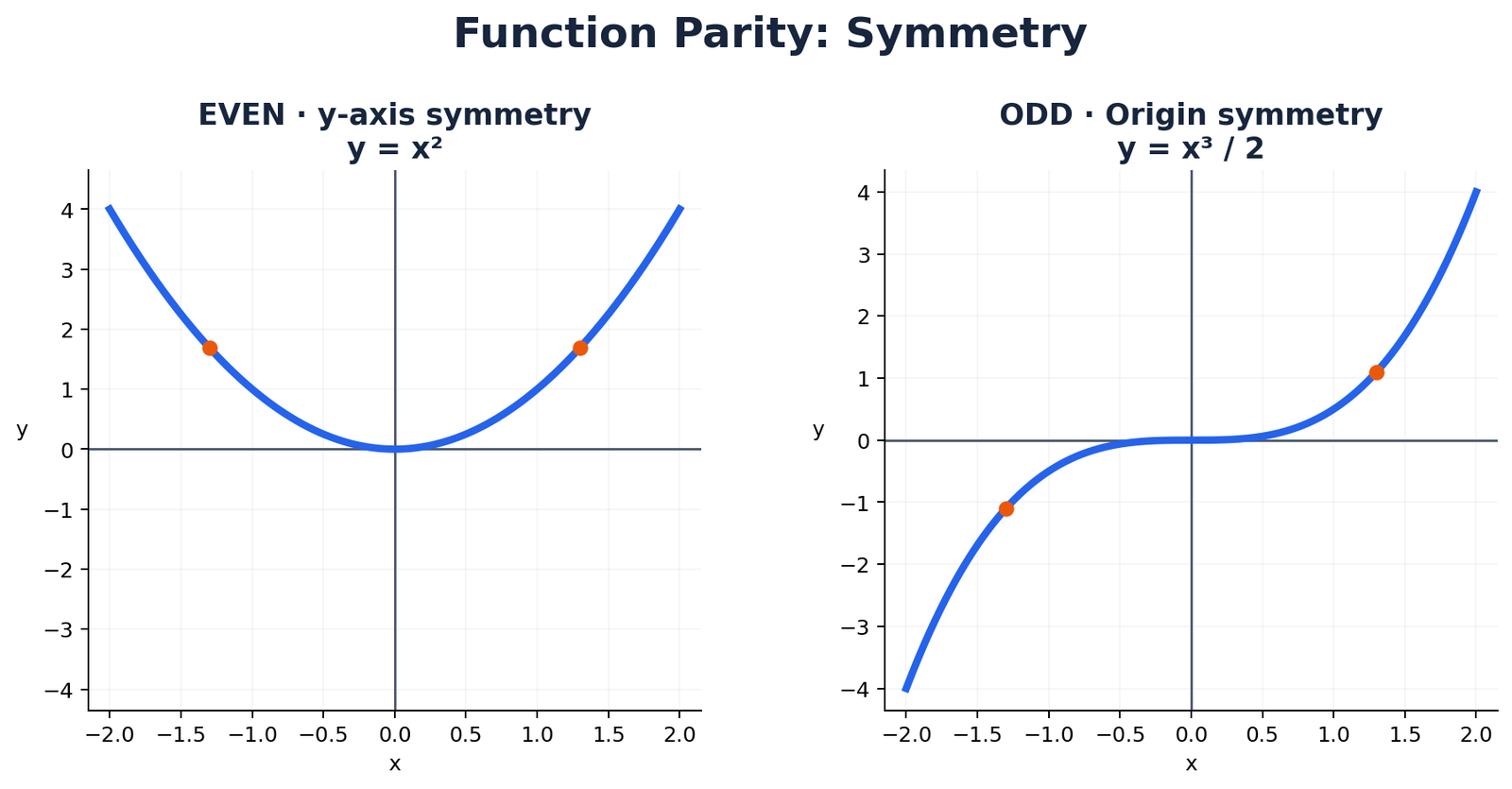
For \(y=x^2\), the points (2,4) and (−2,4) both lie on the graph. For \(y=x^3\), the points (2,8) and (−2,−8) both lie on the graph.
02.3.5 Functions That Are Neither Even Nor Odd
Some functions do not satisfy either identity on their domains.
Example 5 · Mixed Terms
\[f(x)=x^2+x\]
\[f(-x)=x^2-x\]
\[-f(x)=-x^2-x\]
The substituted expression is neither identical to f(x) nor its negative for all x. Classification: neither.
Example 6 · Another Mixed Polynomial
\[f(x)=x^3+x^2\]
\[f(-x)=-x^3+x^2\]
\[-f(x)=-x^3-x^2\]
Neither identity holds for all inputs.
Useful shortcut
A polynomial with nonzero even-power and odd-power terms is neither even nor odd. Always use the full algebraic test for more general functions.
02.3.6 The Importance of a Symmetric Domain
A domain D is symmetric about zero when every allowed input x has its opposite −x in D.
| Domain | Symmetric? |
|---|---|
| ℝ | Yes |
| [−5,5] | Yes |
| (−3,3) | Yes |
| (−∞,−1) ∪ (1,∞) | Yes |
| [0,∞) | No |
| [−2,5] | No |
| ℝ ∖ {2} | No |
Example 7 · Restricted Square Function
\[f(x)=x^2,\qquad x\in[0,4]\]
The formula is familiar, but −2 is excluded while 2 is included. This restricted function is neither even nor odd. On the symmetric domain [−4,4], the same formula is even.
Example 8 · Symmetric Rational Domain
\[f(x)=\frac1x\]
\[D=\mathbb R\setminus\{0\}\]
\[f(-x)=\frac1{-x}=-f(x)\]
The domain is symmetric despite excluding 0, and the function is odd.
Necessary, not sufficient
A symmetric domain is required for even or odd parity, but does not itself prove parity.
02.3.7 Algebraic Method for Testing Function Parity
- Check that the domain is symmetric about zero.
- Calculate f(−x) by substitution.
- Compare with f(x).
- Compare with −f(x).
- State: even, odd, both, or neither.
Example 9 · Even Polynomial
\[f(x)=x^4-5x^2+4\]
\[f(-x)=(-x)^4-5(-x)^2+4\]
\[=x^4-5x^2+4=f(x)\]
Domain: ℝ, symmetric. Classification: even.
Example 10 · Odd Rational Function
\[f(x)=\frac{x}{x^2+1}\]
\[f(-x)=\frac{-x}{x^2+1}=-f(x)\]
The denominator is positive for every real x, so the domain is ℝ. Classification: odd.
Example 11 · Non-symmetric Rational Domain
\[f(x)=\frac1{x-2}\]
\[D=\mathbb R\setminus\{2\}\]
2 is excluded while −2 is allowed, so the domain is not symmetric. Classification: neither.
02.3.8 Common Polynomial and Elementary Function Examples
| Function | Classification | Reason |
|---|---|---|
| \(x^2\) | Even | Even power |
| \(x^3\) | Odd | Odd power |
| \(x^4+2x^2+1\) | Even | Even powers and constant |
| \(x^5-3x\) | Odd | Odd powers |
| \(x^2+x\) | Neither | Mixed nonzero even and odd powers |
| \(5\) | Even | Nonzero constant |
| \(0\) | Both | Both parity identities hold |
A polynomial with only even powers (including a constant) is even; a polynomial with only odd powers and no nonzero constant term is odd.
A polynomial such as \(x^4+2x^3-x^2\) is neither, because it contains nonzero even- and odd-degree terms.
02.3.9 Parity of Basic Trigonometric Functions
Sine and tangent are odd; cosine is even. These statements apply on their natural domains.
| Function | Parity | Identity |
|---|---|---|
| Sine | Odd | \(\sin(-x)=-\sin x\) |
| Cosine | Even | \(\cos(-x)=\cos x\) |
| Tangent | Odd | \( an(-x)=- an x\) |
The displayed restriction is the natural domain of tangent. Its excluded points occur in opposite pairs.
Example 12 · Sine Plus Cosine
\[f(x)=\sin x+\cos x\]
\[f(-x)=-\sin x+\cos x\]
\[-f(x)=-\sin x-\cos x\]
Neither equality holds for every real x, so the function is neither even nor odd.
02.3.10 Special Case: A Function Can Be Both Even and Odd
The zero function is both even and odd on a symmetric domain.
If a function is both even and odd, then \(f(x)=-f(x)\), so \(2f(x)=0\), hence \(f(x)=0\) for every point of its domain.
| Function | Classification |
|---|---|
| \(x^2\) | Even only |
| \(x^3\) | Odd only |
| \(x^2+x\) | Neither |
| \(0\) | Both |
02.3.11 Advanced Worked Examples — Applying Parity
Example 13 · Square Root
\[f(x)=\sqrt{9-x^2}\]
\[9-x^2\geq0\ \Longrightarrow\ -3\leq x\leq3\]
\[f(-x)=\sqrt{9-(-x)^2}=f(x)\]
The domain [−3,3] is symmetric. Classification: even.
Example 14 · Absolute Value
\[f(x)=x|x|\]
\[|-x|=|x|\]
\[f(-x)=(-x)|-x|=-x|x|=-f(x)\]
The function is odd.
Example 15 · Unknown Coefficient
\[f(x)=x^3+kx^2-4x\]
\[f(-x)=-x^3+kx^2+4x\]
\[-f(x)=-x^3-kx^2+4x\]
\[2kx^2=0\ \Longrightarrow\ k=0\]
The function is odd precisely when k = 0.
Example 16 · Infer an Unknown Value
\[f(5)=-8\quad\text{and f even}\]
\[f(-5)=-8\]
\[g(5)=-8\quad\text{and g odd}\]
\[g(-5)=8\]
Parity can determine missing output values without knowing the function’s full formula.
02.3.12 Common Mistakes to Avoid
1 · Confusing f(−x) with −f(x)
Replacing an input is not the same as negating an output. For f(x)=x²+3, f(−x)=x²+3 but −f(x)=−x²−3.
2 · Assuming x² makes every expression even
The function x²+x contains an additional odd term and is neither even nor odd.
3 · Ignoring the domain
The real square-root function √x has domain [0,∞), which is not symmetric about zero.
4 · Assuming every odd function passes through the origin
This is only guaranteed when the function is defined at zero. The odd function 1/x is not.
5 · Assuming f(0)=0 proves odd parity
For x², f(0)=0, yet the function is even and not odd.
6 · Testing one pair of opposite inputs
One matching pair does not prove a universal identity. A counterexample can disprove it.
7 · Forgetting the zero function
The zero function satisfies both identities on a symmetric domain.
02.3.13 Essential Formula Summary
| Classification | Algebraic test | Graphical meaning |
|---|---|---|
| Even | \(f(-x)=f(x)\) | y-axis symmetry |
| Odd | \(f(-x)=-f(x)\) | origin symmetry |
| Both | \(f(x)=0\) on a symmetric domain | zero function |
| Neither | Neither identity holds, or domain is not symmetric | no required parity symmetry |
Always check first
A symmetric domain is a requirement for the even and odd classifications used in this lesson.
02.3.14 Lesson Summary
- Even: opposite inputs produce equal outputs; graph has y-axis symmetry.
- Odd: opposite inputs produce opposite outputs; graph has origin symmetry.
- The domain must be symmetric about zero to classify a function as even or odd.
- Some functions are neither, and the zero function is both.
- Polynomial power patterns can help, but substitution is the reliable test.
- Sine and tangent are odd; cosine is even on their natural domains.
- Check the domain before making a parity claim.