MODULE 02 · FUNCTIONS · LESSON 02.7
Trigonometric Functions
Angles, radians, unit-circle coordinates, exact values, identities, trigonometric graphs, periodicity, equations and applications.
Angle measures
Degrees & radians
Core ratios
Sine · Cosine · Tangent
Exam methods
Exact values & equations
02.7.1 Understanding Angles
An angle describes the amount of rotation between two rays sharing a common endpoint. That common endpoint is called the vertex. There are two principal ways to measure angles:
Degrees
A complete rotation around a circle contains:
A half rotation contains:
A quarter rotation contains:
A positive angle is normally measured counterclockwise from the positive x-axis in standard position. A negative angle is measured clockwise. For example, rotating 90° counterclockwise produces an angle of
\(90^\circ\)
while rotating 90° clockwise produces an angle of
\(-90^\circ\)
Radians
A radian is defined using the relationship between an arc length and the radius of a circle. An angle of one radian subtends an arc whose length equals the circle’s radius. For a circle of radius
\(r\)
and arc length
\(s\)
the central angle
\(\theta\)
measured in radians, satisfies:
The circumference of a circle is:
Therefore, a complete rotation measures:
Thus:
And:
Converting between degrees and radians
To convert degrees into radians:
Use:
To convert radians into degrees:
Example 1: Convert 60° into radians
Simplify:
Final answer:
Example 2: Convert 135° into radians
Final answer:
Example 3: Convert radians into degrees
Convert:
into degrees.
Cancel
\(\pi\)
:
Final answer: 210°.
Standard degree-radian conversion table
Degrees and Radians
| Degrees | Radians |
|---|---|
| 0° | 0 |
| 30° | π/6 |
| 45° | π/4 |
| 60° | π/3 |
| 90° | π/2 |
| 120° | 2π/3 |
| 135° | 3π/4 |
| 150° | 5π/6 |
| 180° | π |
| 270° | 3π/2 |
| 360° | 2π |
Important: When working with trigonometric graphs and calculus, angles are generally expressed in radians unless degrees are explicitly indicated.
02.7.2 Sine, Cosine, and Tangent in Right Triangles
A right triangle is a triangle containing one angle of
\(90^\circ\)
For an acute angle
\(\theta\)
the three sides are described as:
The names opposite and adjacent depend on which acute angle is being considered.
The three trigonometric ratios
The sine ratio is:
The cosine ratio is:
The tangent ratio is:
These relationships are often memorized using:
SOH – CAH – TOA
SOH Sine sin θ = Opposite Hypotenuse
CAH Cosine cos θ = Adjacent Hypotenuse
TOA Tangent tan θ = Opposite Adjacent
Example 4: A right triangle with sides 3, 4, and 5
Suppose a right triangle has:
Find
\(\sin\theta\)
\(\cos\theta\)
and
\(\tan\theta\)
Step 1. Calculate sine.
Step 2. Calculate cosine.
Step 3. Calculate tangent.
Therefore:
The three exact results are:
Example 5: Find an unknown side
A right triangle has an angle of
\(30^\circ\)
and a hypotenuse of length 12 cm. Find the side opposite this angle. Use:
Since:
We have:
Multiply both sides by 12:
Final answer: 6 cm. Limitation: Right-triangle ratios directly describe acute angles. To define sine, cosine, and tangent for larger or negative angles, we use the unit circle.
02.7.3 Understanding the Unit Circle
The unit circle is a circle centered at the origin with radius 1. Every point on the unit circle satisfies:
Starting from the positive x-axis, an angle
\(\theta\)
identifies a point
\(P\)
on the circle. The coordinates of that point are:
This is one of the most important relationships in trigonometry. It means:
Explore the unit circle
Example 6: The angle 30°
For:
the unit-circle point is:
Therefore:
And:
Example 7: The angle 180°
At
\(180^\circ\)
the unit-circle point is:
Therefore:
And:
Example 8: Why tangent is undefined at 90°
At
\(90^\circ\)
the point is:
Therefore:
and:
Since:
we obtain:
Division by zero is undefined. Conclusion: Tangent is undefined at
\(90^\circ\)
\(270^\circ\)
and every coterminal angle with these directions.
Coterminal angles
Two angles are coterminal when their terminal sides point in the same direction. For example:
all correspond to the same position on the unit circle. Adding or subtracting a complete rotation does not change sine or cosine:
In radians, a complete rotation is
\(2\pi\)
This property will be used when studying periodicity.
02.7.4 Exact Trigonometric Values for Standard Angles
In CSCA Mathematics, students should be able to calculate common trigonometric values without relying entirely on a calculator. The most important angles to memorize first are:
Their values can be derived using special right triangles and the unit circle.
Exact trigonometric values
Exact Trigonometric Values
| Angle | sin θ | cos θ | tan θ |
|---|---|---|---|
| 0° | 0 | 1 | 0 |
| 30° | 1/2 | (√3)/2 | (√3)/3 |
| 45° | (√2)/2 | (√2)/2 | 1 |
| 60° | (√3)/2 | 1/2 | √3 |
| 90° | 1 | 0 | Undefined |
| 180° | 0 | −1 | 0 |
| 270° | −1 | 0 | Undefined |
| 360° | 0 | 1 | 0 |
Tangent is undefined whenever cosine equals zero.
Understanding the 45° values
An isosceles right triangle has two equal legs. Suppose each leg has length 1. By the Pythagorean theorem:
Therefore:
Since the acute angles are both
\(45^\circ\)
And:
Understanding the 30° and 60° values
A
\(30^\circ\)
–
\(60^\circ\)
–
\(90^\circ\)
triangle has side-length ratios:
The shortest side is opposite 30°, the longer leg is opposite 60°, and the hypotenuse is 2. Therefore:
This explains the relationships in the exact-value table.
02.7.5 Signs of Trigonometric Functions in the Four Quadrants
The coordinate plane is divided into four quadrants. The unit circle allows us to determine the signs of sine, cosine, and tangent in each quadrant. Remember:
on the unit circle, and:
when
\(x\neq0\)
Quadrant I — 0° to 90°
Both x- and y-coordinates are positive. Therefore, sine, cosine, and tangent are all positive.
Quadrant II — 90° to 180°
The x-coordinate is negative and the y-coordinate is positive. Therefore, sine is positive, while cosine and tangent are negative.
Quadrant III — 180° to 270°
Both coordinates are negative. Sine and cosine are negative, but tangent is positive because the ratio of two negative numbers is positive.
Quadrant IV — 270° to 360°
The x-coordinate is positive and the y-coordinate is negative. Cosine is positive, while sine and tangent are negative.
Quadrant sign summary
Signs of Trigonometric Functions by Quadrant
| Quadrant | Sine | Cosine | Tangent |
|---|---|---|---|
| I | + | + | + |
| II | + | − | − |
| III | − | − | + |
| IV | − | + | − |
This table applies to angles strictly inside each quadrant. Quadrantal angles on the axes must be evaluated separately.
Reference angles
A reference angle is the acute angle between an angle’s terminal side and the x-axis. Reference angles allow us to calculate trigonometric values for angles outside the first quadrant. For an angle
\(\theta\)
between 0° and 360°:
| Quadrant | Reference angle |
|---|---|
| I | θ |
| II | 180° − θ |
| III | θ − 180° |
| IV | 360° − θ |
Example 9: Calculate \(\sin150^\circ\)
The angle 150° is in Quadrant II. Its reference angle is:
Sine is positive in Quadrant II. Therefore:
Example 10: Calculate \(\cos210^\circ\)
The angle 210° is in Quadrant III. Reference angle:
Cosine is negative in Quadrant III. Therefore:
Example 11: Calculate \(\tan315^\circ\)
The angle 315° is in Quadrant IV. Reference angle:
Tangent is negative in Quadrant IV. Therefore:
Exam tip: For nonstandard angles, identify the quadrant, calculate the reference angle, determine the sign, and then use the exact value of the reference angle.
02.7.6 Fundamental Trigonometric Identities
A trigonometric identity is an equation involving trigonometric functions that is true for every input where both sides are defined. Identities are useful for simplifying expressions and finding unknown trigonometric values.
Identity 1: The Pythagorean identity
This follows from the unit-circle equation:
because:
Substituting gives:
The notation
\(\sin^2\theta\)
means
\((\sin\theta)^2\)
not
\(\sin(\theta^2)\)
Identity 2: The tangent identity
where:
This identity allows us to calculate tangent using sine and cosine.
Identity 3: A derived Pythagorean identity
Starting with:
divide every term by
\(\cos^2\theta\)
provided
\(\cos\theta\neq0\)
We obtain:
This is useful in more advanced simplification questions.
Example 12: Find sine using cosine and a quadrant
Suppose:
and
\(\theta\)
lies in Quadrant II. Find
\(\sin\theta\)
and
\(\tan\theta\)
. Step 1. Apply the Pythagorean identity.
Substitute:
Subtract:
Taking square roots gives:
Step 2. Choose the correct sign. The angle lies in Quadrant II, where sine is positive. Therefore:
Step 3. Calculate tangent.
Final answers:
Example 13: Simplify a trigonometric expression
Simplify:
From:
subtract
\(\sin^2x\)
from both sides. Therefore:
Final answer:
Fundamental Trigonometric Identities
Pythagorean Identity
sin
2
θ + cos
2
θ = 1
Tangent Identity
tan θ =
sin θ
cos θ
Tangent is defined only when cos θ is nonzero.
02.7.7 Domain and Range of Trigonometric Functions
As studied in Lesson 02.1, a function’s domain describes its allowed inputs, while its range describes its possible outputs.
Domain and range of sine
Consider:
The sine function is defined for every real angle. Therefore:
On the unit circle, sine represents the vertical coordinate, which can never be greater than 1 or less than −1. Therefore:
The range is:
Domain and range of cosine
Consider:
Cosine is also defined for every real angle. Thus:
Cosine represents the horizontal unit-circle coordinate. Therefore:
Range:
Domain and range of tangent
Consider:
Because:
tangent is undefined whenever
\(\cos x=0\)
In radians, this occurs at:
These are excluded from its domain. Unlike sine and cosine, tangent can produce any real output. Therefore:
Domains and Ranges of Trigonometric Functions
| Function | Domain | Range |
|---|---|---|
| sin x | All real numbers | [−1, 1] |
| cos x | All real numbers | [−1, 1] |
| tan x | x ≠ π/2 + kπ, k integer | All real numbers |
02.7.8 Graphs of Sine, Cosine, and Tangent
Trigonometric graphs are different from polynomial graphs because they often repeat their patterns. The most important graph characteristics are:
Graph A: Sine function
Graph A: Sine Function
y
= sin
x
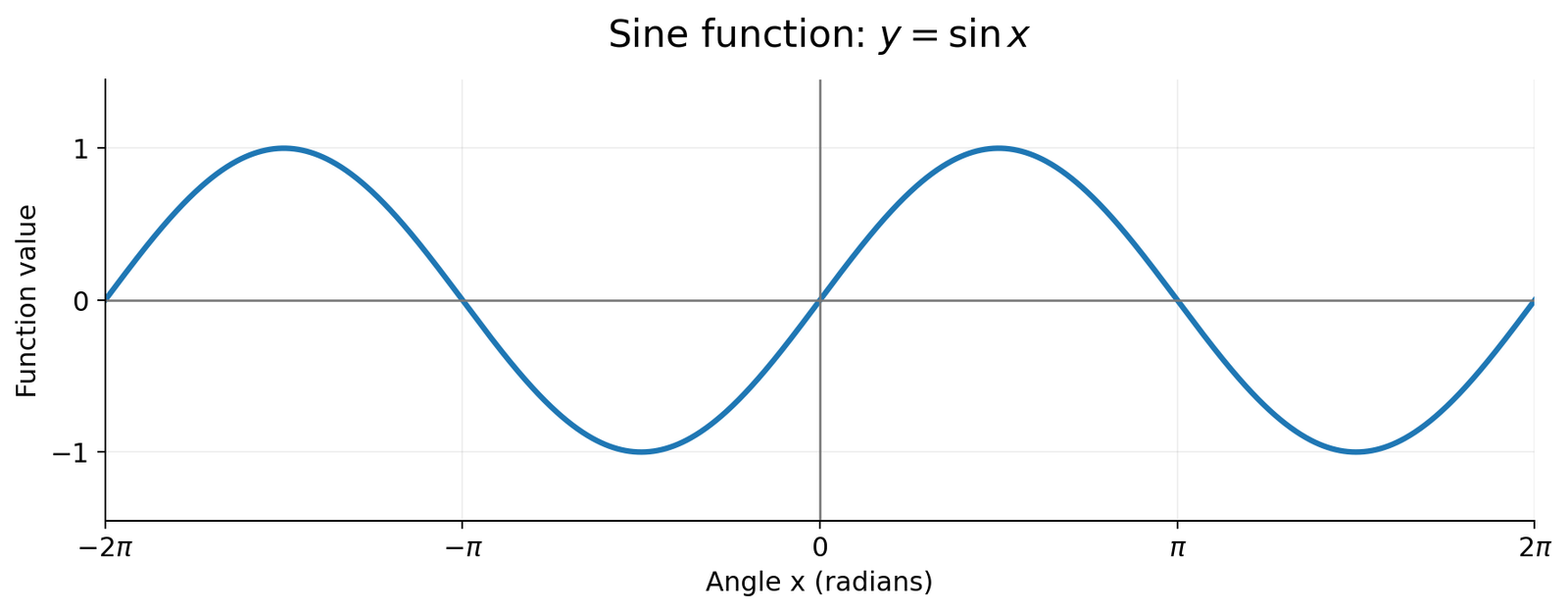
The sine graph forms a smooth repeating wave.
Over one complete period, from 0 to 2π it passes through the values:
| x | sin x |
|---|---|
| 0 | 0 |
| π/2 | 1 |
| π | 0 |
| 3π/2 | −1 |
| 2π | 0 |
Important properties: The maximum output is 1, the minimum output is −1, and the amplitude is 1. Its pattern repeats every
\(2\pi\)
radians, or 360°. Therefore, its fundamental period is:
Graph B: Cosine function
Graph B: Cosine Function
y
= cos
x
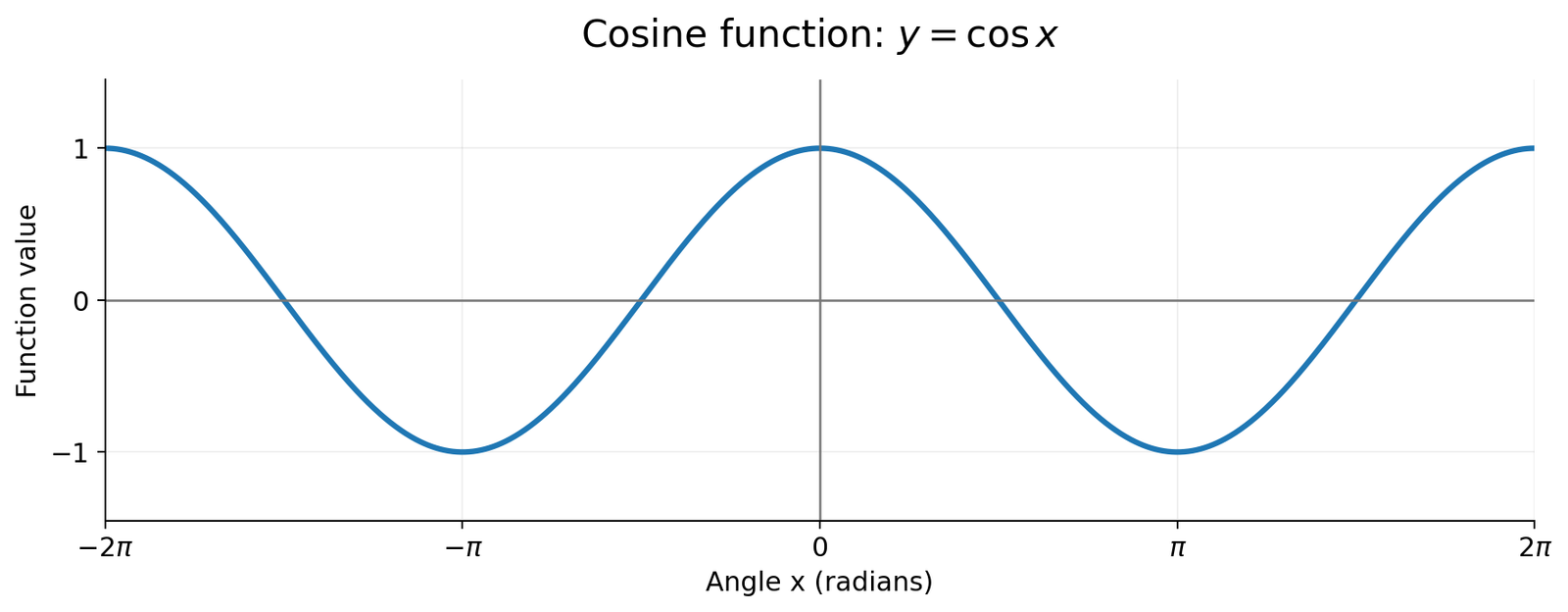
However, at
\(x=0\)
cosine starts at its maximum value of 1. Its key values over one period are:
| x | cos x |
|---|---|
| 0 | 1 |
| π/2 | 0 |
| π | −1 |
| 3π/2 | 0 |
| 2π | 1 |
Its amplitude is 1 and its fundamental period is
\(2\pi\)
Graph C: Tangent function
Graph C: Tangent Function
y
= tan
x
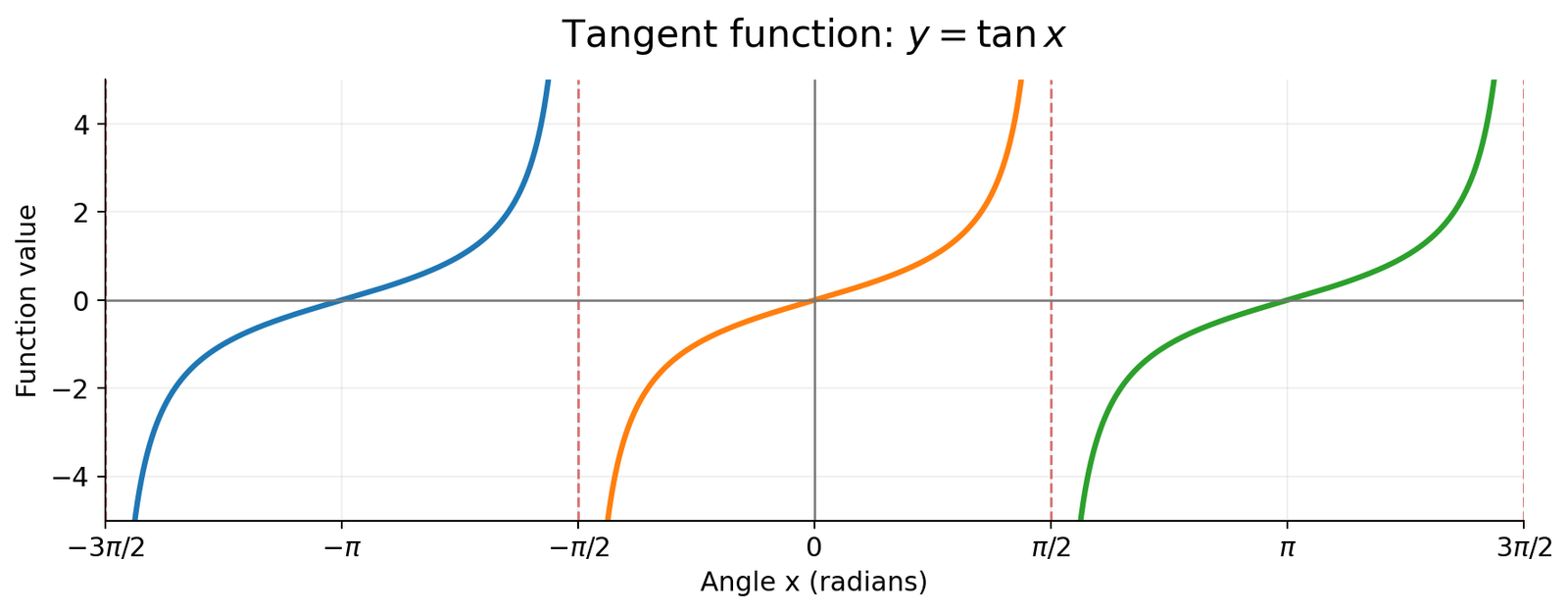
The tangent function has a different shape from sine and cosine. It has repeating branches separated by vertical asymptotes. The vertical asymptotes occur at:
where
\(k\)
is any integer. The fundamental period of tangent is:
Unlike sine and cosine, tangent is not bounded above or below. Therefore, tangent has no finite amplitude.
What is amplitude?
For a sine or cosine wave, amplitude measures the maximum vertical distance from its middle line. For:
or:
the amplitude is:
For example:
has amplitude:
Its range is:
How does the period change?
For:
or:
where
\(A\neq0\)
and
\(B\neq0\)
the fundamental period is:
For tangent:
the fundamental period is:
The coefficient
\(B\)
controls horizontal compression or stretching.
Example 14: Find amplitude and period
Consider:
Step 1. Find the amplitude.
Therefore, amplitude is:
Step 2. Find the period. Here:
Therefore:
Final answer: Amplitude 3, period
\(\pi\)
.
Example 15: A cosine function with a negative coefficient
Consider:
The amplitude is:
The negative sign reflects the cosine graph across the x-axis. For the period:
Therefore:
Final answer: Amplitude 2, period
\(4\pi\)
.
Example 16: Period of a tangent function
Consider:
Using:
and
\(B=3\)
:
The function repeats every
\(\pi/3\)
radians.
Graph properties summary
| Property | Sine | Cosine | Tangent |
|---|---|---|---|
| Basic amplitude | 1 | 1 | Not defined |
| Fundamental period | 2π | 2π | π |
| Range | [−1, 1] | [−1, 1] | ℝ |
| Vertical asymptotes | None | None | Yes |
| Basic value at 0 | 0 | 1 | 0 |
02.7.9 Parity and Periodicity
In Lesson 02.3, students learned that functions can be even, odd, or neither. Trigonometric functions provide important examples of both even and odd behavior.
Parity of sine
The sine function satisfies:
Therefore, sine is an odd function. Its graph has symmetry about the origin.
Parity of cosine
The cosine function satisfies:
Therefore, cosine is an even function. Its graph has symmetry about the y-axis.
Parity of tangent
The tangent function satisfies:
where both sides are defined. Therefore, tangent is an odd function.
What is periodicity?
A function is periodic if its values repeat after a fixed nonzero interval. For a periodic function
\(f\)
a positive number
\(T\)
is a period if:
for every
\(x\)
in its domain, with the corresponding shifted input also defined. The smallest positive period, when one exists, is called the fundamental period.
Periodicity identities
For sine:
For cosine:
For tangent:
Example 17: Evaluating an angle using periodicity
Calculate:
Notice:
Since sine has a period of 360°:
Therefore:
Example 18: Tangent periodicity
Calculate:
Since:
and tangent has a period of 180°:
Therefore:
Parity and periodicity summary
| Function | Parity | Fundamental period |
|---|---|---|
| sin x | Odd | 2π |
| cos x | Even | 2π |
| tan x | Odd | π |
02.7.10 Solving Basic Trigonometric Equations
A trigonometric equation is an equation containing one or more trigonometric functions. For example:
Unlike many elementary algebraic equations, trigonometric equations can have infinitely many solutions because trigonometric functions are periodic. However, examination questions often restrict the interval in which solutions must be found. For example:
means that we only consider angles from 0 up to, but not including,
\(2\pi\)
General solving method
Example 19: Solve a sine equation
Solve:
for:
Step 1. Find the reference angle. We know:
Therefore, the reference angle is:
Step 2. Identify the possible quadrants. Sine is positive in Quadrants I and II. Step 3. Find both angles. Quadrant I:
Quadrant II:
Final answer:
These are all the solutions in the given interval. If the question instead asks for all real solutions, the answers repeat every
\(2\pi\)
or:
where
\(k\in\mathbb Z\)
.
Example 20: Solve a cosine equation
Solve:
for:
Step 1. Identify the reference angle. We know:
Therefore, the reference angle is:
Step 2. Determine the quadrants. Cosine is negative in Quadrants II and III. Step 3. Find the angles. Quadrant II:
Quadrant III:
Final answer:
Example 21: Solve a tangent equation
Solve:
for:
Step 1. Find the reference angle.
Therefore, the reference angle is:
Step 2. Determine the quadrants. Tangent is positive in Quadrants I and III. Step 3. Find the angles. Quadrant I:
Quadrant III:
Final answer:
Because tangent has period
\(\pi\)
all real solutions can be written as:
Example 22: Solve a trigonometric equation using an identity
Solve:
for:
Step 1. Isolate the squared function.
Step 2. Take square roots.
Both signs must be considered. Step 3. Find all angles. The reference angle is
\(\pi/4\)
Since either sign is permitted, solutions occur in all four quadrants. Therefore:
Final answer: Four solutions in the interval.
Common solution patterns
Common Trigonometric Equation Solutions
For 0 ≤ x < 2π:
| Equation | Solutions |
|---|---|
| sin x = 0 | 0, π |
| cos x = 0 | π/2, 3π/2 |
| tan x = 0 | 0, π |
| sin x = 1 | π/2 |
| cos x = −1 | π |
| tan x = 1 | π/4, 5π/4 |
02.7.11 Simple Applications of Trigonometry
Trigonometric functions are useful in problems involving height, distance, angles, and circular movement.
Example 23: Finding the height of an object
A student stands 20 meters from the base of a building on level ground. The angle of elevation from the student to the top of the building is
\(30^\circ\)
Assume the student’s eye is at ground level for this simplified problem. Find the building’s height. Step 1. Identify the sides. Horizontal distance:
Unknown height:
Angle of elevation:
Step 2. Choose the trigonometric ratio. The height is opposite the angle, and the horizontal distance is adjacent. Therefore, use tangent.
Step 3. Substitute the exact value.
Multiply by 20:
This is the exact answer. Using
\(\sqrt3\approx1.732\)
:
Final answer: The building is approximately 11.55 meters tall.
Example 24: Finding arc length
A circular track has a radius of 6 meters. Find the arc length corresponding to a central angle of
\(60^\circ\)
Step 1. Convert the angle into radians.
Step 2. Use the arc-length formula. For an angle in radians:
Substitute:
Therefore:
Final answer:
Approximately:
Important: The formula
\(s=r\theta\)
requires the angle to be expressed in radians.
Example 25: Interpreting a periodic model
Suppose the vertical displacement of a point is modeled by:
where
\(t\)
is measured in seconds and
\(2t\)
is measured in radians. Find the amplitude and period. Step 1. Identify the amplitude.
Therefore, the maximum displacement from the middle position is 4 units. Step 2. Find the period.
Therefore, the motion repeats every
\(\pi\)
seconds. Final answer: Amplitude 4 units, period
\(\pi\)
seconds.
02.7.12 Common Mistakes to Avoid
Mistake 1: Confusing degrees and radians
For example:
But
\(\sin(30)\)
with 30 interpreted as radians, is not equal to
\(1/2\)
Always check the angle unit.
Mistake 2: Reversing sine and cosine
On the unit circle:
Cosine is the x-coordinate; sine is the y-coordinate.
Mistake 3: Forgetting quadrant signs
For example:
not
\(-1/2\)
because sine is positive in Quadrant II.
Mistake 4: Treating tangent as defined at every angle
Tangent is undefined when cosine equals zero. For example:
is undefined.
Mistake 5: Confusing \(\sin^2x\) with \(\sin(x^2)\)
These expressions represent different operations.
Mistake 6: Forgetting the second solution of a trigonometric equation
For:
on
\(0\leq x<2\pi\)
the answer is not just
\(x=\pi/6\)
It also includes
\(x=5\pi/6\)
Mistake 7: Giving tangent an amplitude
Sine and cosine are bounded, and their scaled graphs have amplitudes. Tangent is unbounded and has no finite amplitude.
Mistake 8: Using the wrong period formula
For sine and cosine:
For tangent:
These formulas are different.
Mistake 9: Assuming the range of sine or cosine is all real numbers
The basic sine and cosine functions only produce outputs between −1 and 1.
Mistake 10: Forgetting the requested solution interval
If a problem specifies:
do not include
\(2\pi\)
and do not give solutions outside this interval.
General Strategy for Trigonometric Problems
Step 1: Identify the problem type
Conversion, triangle, identity, graph, equation, or application?
Step 2: Check the angle units
Degrees or radians?
Step 3: Select the appropriate rule
Ratios, identities, special values, or graph properties.
Step 4: Determine the quadrant or interval
Identify correct signs and allowed solutions.
Step 5: Perform the calculation
Prefer exact values where possible.
Step 6: Verify the result
Check signs, undefined values, intervals, and units.
02.7.13 General Strategy for Trigonometric Problems
This checklist consolidates the six steps given in the source material.
02.7.14 Lesson Summary
Trigonometric functions connect angle measurement, geometry, algebra, and graphical analysis. The essential concepts are: